Last year, I wrote a review of Jehuda Reinharz and Motti Golani’s Chaim Weizmann: a Biography that did not end up running in an online publication that is now ceasing operations. Not wanting my work to go to waste, I give it below.
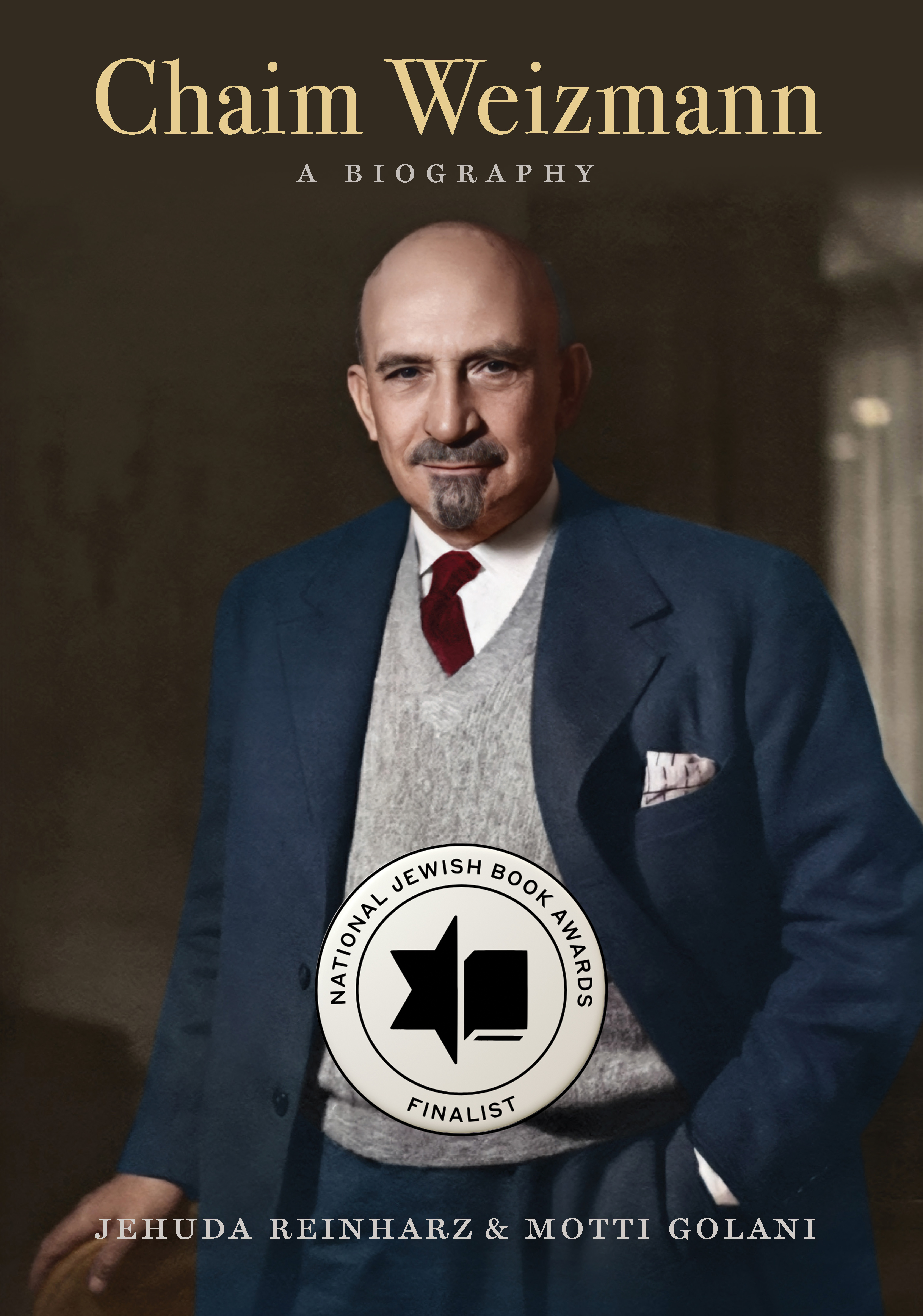
For three decades leading up to the establishment of Israel, Chaim Weizmann was the indispensable man of the Zionist movement—more than any other individual, he prepared the way for the creation of the Jewish state. Yet Weizmann is not particularly well-known today, even in Israel itself.
Historian Jehuda Reinharz has been working to remedy this for decades. In 2020, he and co-writer Motti Golani published the last Hebrew volume of Reinharz’s three-part biography of the Zionist statesman. Those three volumes have now been condensed into a single book by Avi Katzman and translated into English by Haim Watzman. The result is the magisterial Chaim Weizmann, an indispensable work about Zionism’s indispensable man.
Born in 1874 in the Russian Pale of Settlement, Weizmann spent his early adulthood in Central Europe, where he paired the study of chemistry with involvement in the combative environs of the early Zionist movement. In 1904, he left the continent to accept a position at the University of Manchester in England. There, Weizmann found his footing both as a scientist and Zionist leader—by the time the First World War broke out in 1914, he had vaulted to the top ranks of British Zionism.
The outbreak of war brought Weizmann to London and hurled him to prominence. It made his scientific work synthesizing acetone invaluable to Minister of Munitions David Lloyd George (soon to become prime minister). It set Britain against the Ottoman Empire, which had ruled Palestine for four centuries. And it disrupted the normal operations of the World Zionist Organization (WZO), which found its leadership divided among the warring powers. With sudden access to Whitehall—and without his WZO superiors able to assert much oversight—Weizmann set about making the Zionist cause Britain’s own.
It worked. The result was the Balfour Declaration, Britain’s pledge to create a Jewish “national home” in Palestine. While the triumph was not Weizmann’s alone, Reinharz and Golani demonstrate that it was undoubtedly his–as were his subsequent successes securing the flimsy promise’s inclusion in the League of Nations Mandate by which Britain would rule Palestine until 1948. With these achievements, Weizmann emerged as the clear leader of the Zionist movement, a position that was formalized with his 1920 election as president of the WZO.
The work did not end with Balfour. Britain’s commitment to the declaration was always tenuous, especially as Arab opposition mounted. As Reinharz and Golani show, Weizmann’s perennial achievement was in keeping the British committed to it as long as he did. By the time Britain did begin walking back its pledge in the late 1930s, the Zionists had already spent two decades building up the Yishuv (the Jewish community in Palestine) through immigration, land purchasing, and investment, and had developed proto-state institutions through the Jewish Agency—another Weizmann creation. The foundations of a possible Jewish state had been laid.
Even as Britain turned away from Balfour, it was Weizmann who seeded the idea that ultimately provided the basis for the establishment of Israel in 1948—partition. And even as rival David Ben-Gurion pushed the aging Weizmann from the presidency of the WZO in 1946, Weizmann’s diplomatic heft still proved essential in securing the support of the international community—especially US president Harry Truman—for partition and Israeli statehood.
Weizmann remained the indispensable man. It was only with the establishment of Israel, and with his election as its first president, that he suddenly and painfully found himself dispensable—an irony that Reinharz and Golani poetically capture in the book’s penultimate chapter. Weizmann was never really at home in the state he helped create.
Reinharz and Golani document and contextualize Weizmann’s many achievements well, all in keeping with the authors’ goal to “give him his due as Israel’s founding father” (xvii). The work’s greatest strength and interest, though, lay in the authors’ understanding of the man and how he operated. Weizmann is a fascinating study in that regard. He could veer wildly between total self-possession and illness-inducing self-doubt. He craved constant affirmation and demanded total loyalty from collaborators, whom he could cruelly cast aside. His achievements were beyond doubt, yet he continuously embellished them. He was in so many ways an exhausting, exhausted man, yet also undeniably magnetic.
Weizmann’s successes came where that magnetism could make him most effective—cultivating networks of well-placed allies, both within and without the Zionist movement. Among the core strengths of this biography is Reinharz and Golani’s ability to map out these ever-shifting networks. They are, in a sense, the main story. The most important of them, both in securing Zionist priorities and in guaranteeing Weizmann’s place at the head of the movement, was that of the British political elite. Weizmann counted prime ministers and cabinet secretaries among his friends and allies. He even counted some of them—like William Ormsby-Gore and Malcolm MacDonald—as his proteges, at least for a time.
Weizmann’s comfort among the British elite calls to mind American columnist Dorothy Thompson’s description of him as “a complete Jew” who “sits in his Jewishness as easily and proudly as an Englishman sits in his Englishness.” As Reinharz and Golani show, the Russian Jewish immigrant sat just as easily and proudly in his Britishness. At once a fully committed Zionist and a fully convinced British imperialist, the British-Zionist alliance he built made intrinsic sense to Weizmann. More than anyone else, he could make it make sense to others. Weizmann’s successes as a Zionist leader evolved from that—from hitching Zionism to the interests of the British Empire. It was a strategy that worked, both for Weizmann and for the movement. From Britain’s momentary wartime interests came the “national home.” From the national home came the Jewish state.
As Reinharz and Golani note, one of Weizmann’s guiding principles for Zionism was for Jews “not to rule and not to be ruled” (802). In this, as in many other things, Weizmann represented a moderate vision of Zionism that the authors clearly hope to revive. But the question remains whether a Zionism hitched to empire could ever have produced the state he sought. “I do not want this gift to blind my eyes,” one of Weizmann’s allies-turned-rivals, Judah Magnes, had written of the British Mandate in 1920. Twenty-nine years later, when Weizmann was sworn in as the first president of Israel, he could barely see.

